alexsarll: (default)
Feels like life has been fairly quiet of late, (except when it hasn't, of course - Hyde Park picnics, Leyton pubs that are at least decently apologetic about hating my people, SE14's answer to the Shaftesbury). But in early summer, especially this year as it's still picking up from the tardy spring, I don't mind that. The evenings are still simply beautiful, without that complex melancholy they acquire later on - though it would help if I had the park for them, when instead it's being turned into some sort of prison camp for Madchester arseholes (sorry, tautology, I know). Still, I've had my chances to go a-roaming - up trees, over banks, through hedges and across a Heath resplendent with buttercups like I've never seen. Even got to share a tree with a jay at one point - a much better companion than parakeets, who may be beautiful, but in prolonged proximity are no better than the sort of person who wears Beats By Dre headspeakers. Guessed a stranger's dog's name, too - though given my guess was Slobberchops, based on obvious physical features, I don't think that's much proof of psychic potential.

Been watching a lot of adventure series lately - The Avengers, Brisco County Jr, Adventure Time - and hardly any films. One exception: Night of the Eagle, which as the name suggests is close kin to the MR James adaptation Night of the Demon. Peter Wyngarde - excellent value as ever - plays a sixties Richard Dawkins who discovers his wife's a closet witch and makes her burn her "protections", after which their lives go about as smoothly as you'd expect. There are loose plot threads all over the place and it doesn't even seem quite sure whether magic works or not in its world, but it's thoroughly eerie nonetheless. Spartacus ended for good, and Doctor Who for now; the former was the downer it was always going to be, the latter much better than I'd dared expect, though it may have helped that I had the contrast of having just finished the rambling Reign of Terror, the first full Hartnell I've attempted in a decade or more.

And then after 'The Name of the Doctor' there was Eurovision, in which as ever the worthy victor was robbed - this time it was Romania (or rather Romoania) with the gay dubstep vampire. We left after that and Bonnie Tyler to see The French Electric live down the road, sounding like the National before they went boring, covering songs from Dare! and getting away with it. They were followed by a tragic act who could have sounded like Mazzy Star or Lana del Rey if only the drums had been turned down (or preferably off), which was my cue to depart. Thee Faction and Joanne Joanne at the Buffalo Bar were excellent, same as last time they played there together, and once again I drank entirely too much. Possibly because I'd realised that, if they're a genderswapped Duran Duran and Keith and I had been hanging with them in the pub earlier, that made us genderswapped 'Girls on Film' video babes. I should possibly be seeing them again tonight, but outside was calling, and I'm still in a certain amount of gig-shock after seeing the Art Brut birthday gig on what they weren't allowed to call the Glass Ceiling Tour. Ten years! They've learned a lot in that time, though. And the Scala...I'd forgotten how much I liked that venue. I'd forgotten how much I like the rare big gig - and it turns out they do still exist - where the crowd Get It. And the support slot from Keith et al wasn't bad either - I think the best show I've seen them do since the Devant support with the spiralling, near-infinite 'One Thing After Another'. They're a big band, a big stage suits them.

Anyway, my dears, I think I need another cup of decaf tea before Justified. It's a rock'n'roll life and no mistake.
alexsarll: (Default)
I haven't been up to a huge amount lately; judging by today's sun the time of hibernation may be ending, but there's been a lot more reading and DVDs than antics. Spot of furniture construction for [livejournal.com profile] xandratheblue (sometimes I wonder if I may have overdone the John Steed-style 'pose as feckless incompetent' bit, people do get very surprised when I'm practical), comedy then pub on Sunday (Michael Legge especially good as the bewildered MC, Steve Hall from Klang talking more about his swimsuit area than I might have wished, but still excellent). I've watched a lot of films, but more on them later in the week, I think. Two series finished and one promising new show started, so let's keep this one televisual.

My hopes for BBC One's new space colonisation drama Outcasts were not high; I'd heard bad things about how the makers didn't like it being considered science fiction, and as a rule that just means someone is making very bad science fiction. Imagine my surprise when it turns out to be the hardest SF I've seen on TV...possibly ever. And that's hard in both senses; the set-up is not that far off Firefly, but this is a lot less jaunty and swashbuckling. This is about the hard slog of the early days, the muttered references to how bad things were on Earth, the realisation that humanity is down to a few thousand people and even they can't live peacefully together. A good cast - Liam Cunningham, Hermione Norris, Keats from Ashes to Ashes and Apollo from BSG - but not all of them make it to the end of the episode. I like it when shows kill off major characters unexpectedly, it helps to maintain the sense of jeopardy.

Primeval used to be good at that too. This series, not so much, even though the protagonists have suddenly developed a quite uncanny ability to go on missions without adequate back-up, then drop their guns. Since ITV attempted to cancel their one good programme - for showing up everything else they produce, I assumed - it has got visibly cheaper, not in terms of the monster CGI (still great) but in terms of what seems a hurriedness to the writing, and a weird emptiness of the sets. They've saved a ton on extras, but ended up with something that feels a bit too much like Bugs, if anyone remembers that. But if nothing else, it's the only TV drama I've spotted which has any interest in demonstrating the evils of PFI.

But for really getting through the main cast, since Oz ended there has been nothing to equal Spartacus: Blood and Sand. I'm not surprised they're following it up with a prequel, because there really aren't many characters left to follow into the future except Spartacus himself, and Andy Whitfield is too ill to resume that role, poor bastard. And of course prequels have their own problems, because you know who's going to make it. So this may turn out to have been essentially a one-off - but what a one-off. Looking back, even in the earlier, sillier episodes the big theme was there, and that theme was the real trickledown effect. Not the happy, fluffy right-wing fantasy where we all get rich off the very rich's spending - the real version, where the moment's whim of someone higher up than you can up-end (or simply end) your whole life. Again and again, person A suffers simply because B has just had a row with C. And especially when B literally owns A, that can be fatal. Even when they don't, a catastrophic cascade can still result - but the indignities and worse, the difficulty of love or friendship, of being unfree are powerfully drawn. And where the corny old film of Spartacus used this haunting horror of slavery to praise the American Dream, to show how much better things are nowadays, the TV show is made in darker, wiser times. It knows that, unless there happen to be a couple of oligarchs watching, the audience are slaves too.
alexsarll: (Default)
David Niven starred in my favourite film ever, and though I don't remember much about his autobiography The Moon's a Balloon, I do retain a sensation - as with some marvellous party - that it was utterly wonderful. So over Christmas I've been dipping into Bring on the Empty Horses, his selection of brief memoirs and pen portraits of other Hollywood greats. And make no mistake, Niven is a terrible name-dropper - but he lived a life where the names were worth dropping. So we get him playing a round of golf with Clark Gable and Douglas Bader, or escorting a pissed F Scott Fitzgerald off the set (where a cricket game has been set up like baseball because William Wyler's a pillock), or being literally thrown to the sharks by Errol Flynn. He was there when Humphrey Bogart's kids met Noel Coward, he got roped in when Frank Sinatra wanted to take Kruschev's wife to Disneyland himself, and he had the misfortune to be sat next to Spencer Tracy at Jimmy Stewart's stag night. He's not the greatest prose stylist who ever lived, but he's OK, and with material like that, OK is all you really need. And with perfect timing, just as I was finishing it off my free Lovefilm trial sent me The Bishop's Wife, in which Niven - normally one of the most charming men who ever lived - has the twin handicaps of playing an overworked stuffed shirt of a bishop, and having Cary Grant - the most charming man who ever lived - playing opposite him as a rather unconventional angel. The whole thing comes across like a Wings of Desire for a simpler - if not altogether naive - age. And given it's all about Christmas miracles, it turned up just in time - if I'd watched it any later than yesterday the Yule Goblins might have got me.

In the evening, [livejournal.com profile] xandratheblue brought over a film which was somewhat different: Zombie Strippers!. But for all the deiberate, gleeful trashiness of the film, it's also surprisingly smart. Robert Englund, for instance, plays one Ian Essko, and his strip club has rhinoceros iconography. His partner is called Madame Blavatsky. Each of the strippers represents a different approach, drawn from the history of Western philosophy, to trying times. The zombie virus affects women less rapidly than men - so the patrons of the strip club get dehumanised much more drastically than the women, who in the short term seem empowered. Certainly it is not quite as clever as it thinks it is, but it's a lot cleverer than the middlebrow drivel which normally wins film or book prizes for addressing these issues. Also, it has more breasts and headshots.

Spartacus: Blood and Sand is another hybrid of carnage and smarts, in rather different proportions. Like all the best American TV of recent years, it's about America - and because of the way the past few decades went, that means it's about the world. A world where the poor are enlisted as allies, betrayed, and then when they protest, enslaved and sent out to die. The rich don't even enjoy their power because they're so busy jockeying for position amongst each other. But John Hannah and Lucy Lawless own this show, and they're playing the squeezed middle - trying to edge their way up the ladder even as they get sort-of-rich on the suffering of the real poor. Well, at least they can still afford (on credit, of course) a few little luxuries, like slaves to deal with the foreplay before they start screwing. Because while yes, there is some sand, like I said on Facebook a better title would have been Spartacus: Blood, Nudity and Swearing. The foul language is inventive in almost the same way as Deadwood or The Thick of It - albeit also occasionally ludicrous. Something one can say for the violence too, done in an OTT, stylised fashion with fountains of bright red blood that would be risible if 300 hadn't paved the way. You can tell this didn't cost as much as HBO's Rome, say, but it works, mostly. And this in spite of what could have been a major problem - to wit, none of the gladiators can act. Well, Spartacus himself just about manages it, but I think the rest are wrestlers or Gladiators in the modern sense or something. However, they all look suitably tough and get more than sufficiently bloody when they get in the arena (or scrap outside it), so they'll do. Oh, and also, Spartacus isn't actually called that, but so far he keeps getting stopped by something or other whenever he's about to tell us his real name. I bet the season finale reveal is that it's Trevor, or possibly Biggus Dickus. All of this is from Starz, the US cable network that's co-producing the next series of Torchwood. If they handle all of their output like this, it could be spectacular.
(Update: some details about that Torchwood just came through - and interestingly, they play into Lawrence Miles' theory about Jack-style immortality somehow becoming a cancer on reality. Which I'm sure is entirely coincidental, and I'm equally sure Miles won't see that way)
alexsarll: (bernard)
Tom McCarthy's C made the Booker shortlist and had lots of people talking about a rediscovered ambition in the British novel (by which they of course mean literary novel). And yes, OK, it's not about adultery in Muswell Hill, or indeed adultery among the Victorians. It's about sex, drugs, war and the birth of the modern, about secret connections and correspondences, and above all communications. It depicts a dizzying world underlaid by occult traceries. Does that sound familiar? It should, because it is quite blatantly a shorter, less lunatic Gravity's Rainbow. Is that really so impressive? There are some wonderful passages in here, paragraphs about codes, signals - and thus, implicitly, the novel itself - which sparkle with insight and poetry. But which also make me think that McCarthy might be a lot better off as an essayist.

Hallowe'en weekend obviously meant packing in as much spookiness as possible, starting on Wednesday with a trip to the Crypt Gallery on Euston Road. It's a wonderful space, which even saved work I wouldn't have found too interesting in the normal white-walled room, and made good pieces better; my friend's film piece had a caryatid's jug (not like that) outside its alcove door, and the rubbings of the Bank of England seemed like Rosetta stones. There was, however, one piece which in any setting could only have looked like a bell-end.
Friday was perhaps not that spectral; Ale Meat Cider did have on one cider called The Devil's Device, but it was overshadowed (de-shadowed?) by an incredibly cheerful dog called Jasper. Saturday I did my usual and dressed up as Dracula (the Christopher Lee version this year, thanks to Mark Gatiss reminding me of the joy of Hammer) for a trip to the Lexington. And Sunday was centred on the Psychoville special - I liked that they gave everything but the framing story to unreliable narrators, so freeing us from any worry about canonicity or resolving last season's cliffhanger, and leaving them free to concentrate on chilling the blood. Not that any of it could be quite such agonising viewing as Steve Coogan and Rob Brydon in The Trip last night. So uneventful, yet so very savage.

Solomon Kane is one of the other, less famous creations of Conan author Robert E Howard. He's a Puritan swordsman whose defining characteristic is his determination; he does what needs to be done. Solomon Kane is a film in which James Purefoy supposedly plays him. Except here he's a dithering arse, who having done evil in the past now thinks that only being peaceful - to the point of allowing children to be murdered in front of him - can save his soul. Now, these scenes have a valid point to make about the moral bankruptcy of pacifism, but they're deeply anachronistic for the morality of 1601 in general, nevermind the character of Solomon Kane. But this is not a film much bothered about anachronism or fidelity; we also see the great Puritan taking refuge in a monastery (itself a fairly rare commodity in England in 1601). Purefoy is also affecting what's meant to be a Devon accent but in fact serves only to extinguish his sex appeal, and several times we see pistols (one-shot weapons back then) used to put the wounded out of their misery, rather than saved for emergencies. On top of which, they make the same mistake as the Judge Dredd film; a character who is largely meant to be a force of nature ends up in an all too human plot about his family. It's not wholly worthless - the opening scenes in Africa get the authentically Howard feel in for some carnage both human and demonic - but it's still a massive misfire.
alexsarll: (Default)
Yesterday I finished a peculiar little book which left me almost more interested in its publisher than itself. Capuchin Classics have borrowed the green Penguin are no longer using for their modern classics - or perhaps one a shade away from it. They otherwise have a more uniform look, though - and not a bad one, pencil drawings for the covers, all very tasteful. The indicia lists not a publisher or editor in chief, but a chatelaine. And their selection includes a few standard, public domain classics - and then a lot of books like this one of which I had never previously heard. Clearly a labour of love; I approve.
The book itself was The Green Child by Herbert Read, of whom I knew little except that he wasn't conventionally known as a novelist - apparently this was his only one. Apparently he was an anarchist poet and critic; of those three descriptors, only 'poet' would you deduce from The Green Child. There are parts where I was reminded of Graham Greene, who supplies the introduction - except that this is a Greeneland where everything works out for the best, in peace. Something about the quality of the light made me think of Firbank, except that there's none of his fussiness in the style or his loucheness to the content. As the title suggests, the story deals with the myth of green children, except updated to the nineteenth century. Or at least, half the story does, because while the protagonist is returning to the sleepy English village where he grew up, he spent much of his life - and more than half the pages - leading the South American republic of Roncador (yes, of course it got namechecked in League of Extraordinary Gentlemen) - hence a Study in Scarlet situation where for most of the book we're away from the ostensible interest. Still, it does mean we get two rather unsettling but apparently sincere utopias in one short novel, and that's some going.

Not a week of great eventfulness, unless you count the strictly local excitement of a new Sainsbury's on the Maisionette Beautiful's block. The weekend saw another fine Nuisance and another Dons rehearsal (we shall be on the internet wireless tomorrow at 2pm), and an engagement party en route to which I again took the gamble of a 'shortcut' along the canal. If this has ever worked, it doesn't with the works currently underway, but it can produce other, more interesting results. Such as finding oneself on a floating walkway which leads, ultimately, to St Pancras Old Church and Coroner's Court - two key locations in the Bryant & May book I read recently, as spookily London as one could wish in the autumn twilight.

My free Blockbuster trial* is up now, and the last of the DVDs have been watched and returned. Odd blighters they were too: both Youth in Revolt and Observe and Report star stars of Superbad, but neither is funny. At least in the latter case it seems to be deliberate. The set-up - mall security guard with delusions of grandeur - could easily have been funny. Keep the exact same script and cast Will Ferrell, you'd have a comedy. But the way Seth Rogen plays the part, it's really quite upsetting. And intermittently brilliant, especially when it skewers the standard Hollywood rhetoric about sticking to your dreams &c.
Also seen: Joe Meek biopic Telstar, which is very good though I preferred the early, funnier hour; and Centurion, in which Dog Soldiers director Neil Marshall basically remakes his bonkers Doomsday, except this time it's the real Hadrian's Wall instead of a near future one, and shot in the real Scotland instead of South Africa. Whether it has the right idea about the fate of Rome's Ninth Legion I don't know, but it does have a damn fine cast (David Morrissey, Noel Clarke, Dominic West whom some readers might like to know spends much of his appearance topless and/or in chains), and some Iraq resonances which are fairly deftly handled, and an awful lot of gore. Albeit some of it historically inaccurate gore, because the Roman legionary's gladius was not a slashing sword.

*Not strictly free, in that it's a quid for a month. But because I'm signed up to Cashback Kings, I get £7.50 back, so in fact it works out better than free. I got a tenner from a Lovefilm trial via the same method, but that only lasted half as long. Swings and roundabouts.
alexsarll: (bill)
Stringer Bell is going to be in Branagh's Thor film. And we already knew Titus Pullo was involved, probably as Volstagg. I SAY THEE YAY. And speaking of things HBO, while the final Generation Kill did editorialise a little, while I don't think it's ever going to be as beloved as The Wire, that was an extremely good series - maybe even more so than The Wire it did a brilliant job of humanising the characters you hated, showing why they were such utter dicks, with even Godfather getting his moment at the end.

To my amazement, the proposed internet laws in the Queen's Speech were even worse than expected. If you've not been keeping up with the minutiae: the Government commissioned a report, Digital Britain, on how to reconcile the interests of the creative industries with those of net users. This report said that while unlicensed file-sharing was indeed rather naughty, internet disconnection was too draconian a penalty even for the guilty, never mind how many innocents would also be punished (Mum and Dad for the kids' filesharing, or a whole town for one illicit movie). So obviously, because we know how the government regards facts as dangerously subversive (just ask Professor Nutt), Peter Mandelson elbowed the relevant minister out of the spotlight, countermanded the report his own government had commissioned (they obviously didn't appoint a tame enough investigator, Hutton must have been busy), and countermanded anything sensible in it to put three-strikes disconnection back on the agenda. And, we now learn, so much more.
This in a world where Rupert Murdoch, until recently New Labour's bestest pal, talks about putting a pay wall around the websites of his various ghastly papers while stealing content from Edgar Wright. But you can bet that even if that happened two more times, even under the new rules, News International wouldn't get disconnected. In spite of how even musicians who don't make nearly as much money as they should would rather be ripped off online than live in a country which thinks disconnection is acceptable. The only consolation is that the relevant bill is profoundly unlikely to make it through before Goooooordon Brooown loses the next election. Not that I expect the other flavour of scum to propose anything better, you understand, but sometimes delay is the best you can hope for. After all, the horse might talk.

The Black Casebook collects a dozen strange Batman stories from 1951-1964, which is the period when the comic was as stupid as the old Adam West TV series, but without having to worry about the limited budget. So, Batman could be turned into a hulking monster, or find himself on an alien world called Zur-En-Arrh - which, if you've read Grant Morrison's run on the character, should explain why this collection has been put out, and why I was reading it. He contributes an introduction (although one which disagrees in some respects with the contents - he mentions 'The Rainbow Batman' when the book instead has 'The Rainbow Creature'. All the campy old elements are here - Bat-Mite and Ace the Bat-Hound - and by no sane standard are the stories or the art any good. Even the ideas are not so much "mad, brilliant ideas" as half-formed and hurries, born of desperation. Mainly it serves as a testament to Morrison's own talents, going back over the history of Batman and managing to find resonance even in these stupidest of stories which most modern writers would prefer to forget about.
Also, I know it's hardly novel to suggest Batman and Robin came across as a bit gay back in the day, but this book opens with 'A Partner For Batman' where you really can't avoid it. Robin has broken his leg just as Batman is about to train up a new Batman-type for an unnamed European country. Except Robin is convinced this is just a cover story and Batman wants to drop him in favour of Wingman! Cue such lines as, while Batman carries the injured Robin like a bride, "Batman's doing his best to sound gay. But I can tell his heart isn't in it!". And, from one onlooker, "A man is better than a kid any day!". Poor discarded twink.

Haven't had the energy or the funds to be out and about so much this week; even daytime wanders have been a bit sub-optimal, like yesterday when Highbury was deserted and instead of relishing this, I just wondered if it was anything to do with how very tentacly those red-leaved plants look once the leaves are finally gone. But, this just makes me look forward to tonight's Black Plastic all the more. Makes the weekend feel like a weekend, something which can rather slide when one is away from the habit of the working week.
alexsarll: (crest)
I always tended to take from the weekend before Christmas up 'til the 2nd off anyway, so it's only since the day after Bankside Twelfth Night didn't bring a rude awakening that it really started to sink in; yes, I am now a gentleman of leisure. When I was lounging around before, watching Caligula and Bagpuss** - that I would have been doing anyway, redundancy or no. But yesterday, watching a spot of Carnivale, reading a book about giant monsters, and heading down to Sir John Soane's before meeting a friend for drinks at half four...that was liberty. And it helped that Sir John Soane's was even more eccentric and crepuscular than usual, with the heating on the blink and candles providing most of the light, such that when you catch sight of yourself in the mirrors, surrounded by the past, there's a real flash of Crooked House possibility that you might be back there, or they might be here. Anyone comes to me with their "consensus that work is good for people", they're going to get laughed out of town.

*Never having seen the full-length version before...blimey. It's not that I've never seen such things before, just not normally in films which also feature Sir John Gielgud and Dame Helen Mirren. Untrue, though, as is sometimes said, that the extra filth is plot-irrelevant stuff; that's just our culture's latent prudishness showing its ugly face again. There is some gratuitous material, it's true, but other bits make much more sense of Caligula's relationships with his betrothed, his sister and his wife.
**And never mind that juxtaposition - the vagaries of the alphabet have landed that dear saggy old cloth cat next to Baise-moi on the shelf.
alexsarll: (seal)
The Wilton Road exit of Victoria underground - why exactly was it closed for a fortnight? They've not even stuck up electricity-hungry mediatronic ad screens, which seems to be the main 'improvement' visible after all the other disruptive works on the station, or replaced the broken tiles on the floor.

The British Museum's Hadrian exhibition is well worth a look if you get chance. It's nothing like as caught up in tendentious claims of contemporary 'relevance' as the advance press could suggest - yes, we get it, Hadrian pulled out of Mesopotamia aka Iraq. And Rome was very dependent on olive oil. And...the Wall has something to do with the rise of the SNP, maybe? Forget that, all of it. If you get chance, read Marguerite Yourcenar's literal ghostwrite of Hadrian's Memoirs* beforehand, that'll bring you closer to how much he has in common with us simply by being recognisable as a human and an individual across all that gulf of years. Somehow it helps that one of the statues of him - the only one native to Britain - is rubbish, making him look like a monkey. The most impressive one's at the entrance, fragments only pulled from the Turkish sands within the last year, unseen between Then and Now. Flawed and human, but with all that gulf of years...it brings time home to you, or it did to me. Surprisingly few things can do that.
The statues of his lover Antinous are interesting. The giant head is beautiful, but the one of Antinous as Osiris is a puzzler. I've never seen a statue look embarrassed before; noble, nonplussed, even long-suffering like the !William Huskisson statue in Pimlico Gardens, but never like they'd been caught in a sex-game by someone inappropriate. And really, who makes a statue of a male lust object as Osiris with a notable bulge under the loincloth in place of said god's mythical lack? These Romans were crazy!
What else? Some giant metal peacocks from Hadrian's mausoleum - I wondered whether people living in an age before Ray Harryhausen would have been as certain they were about to come to life. And a glass bowl from the Jewish revolt which didn't even look old, much less historical; if you found it you'd just use it for fruit, not call a museum. That says so much more about the relevance of history than some cheap line about the turbulence of the Middle East.

Guy's hospital is so much more impressive and ominous than the cheap facsimile they had the Judoon nick in Doctor Who, isn't it? I do wish they didn't always have to use the London Borough of Cardiff, it's really not an adequate substitute.

*Her manuscript is there, tucked away to the side of the route in, easily missed.
alexsarll: (seal)
Looks like tomorrow's the final Fosca show; a shame not only in itself, but because that's a second band this year with whom [livejournal.com profile] hospitalsoup won't be playing a London farewell show. Which said, I can definitely appreciate Dickon's reasons, and if anything the knowledge of an ending makes me look forward to it even more than I already was.

Which reminds me, the final episode of the show I'm at last prepared to call Jekyll was possibly the best of the lot (especially the really-quite-obvious-once-you-realise-it-take on what emotion Mr Hyde represents; I think it was only having Alan Moore's LoEG take on the character in the way that stopped me spotting it sooner). And The Shield, as ever, managed to find a whole new level of Hell to which it could descend. But the Take That Star Stories? I wasn't convinced. I think the mistake was in having Gary Barlow do the voiceover, as against a generic voiceover guy with a pro-Barlow agenda. I can't see how that change alone was enough to kill it for me; perhaps the ensemble had changed too, or they lost a writer? But as if a switch had been thrown, I just wasn't amused anymore.

If puritanism really had no part in the smoking ban, and it was purely a public health issue, I look forward to the imminent ban on the relevant printers in all workplaces.

There are plenty of depressing periods in world history, but the worst are the ones which manage to be incomprehensible as well as miserable. I've just been reading up on the Hellenistic Age; like the Carolingian era, it basically consists of a great emperor's heirs squabbling over his legacy like particularly vicious jackals - and all having the same bloody names while they're about it. So various Philips, Alexanders, Ptolemys and Antigonuses make alliances with one against the other, shift allegiance the first time they see an advantage in it, and generally make one despair for coherence as much as humanity. Things reach a low point - by any definition - when one particularly obese and unpleasant Ptolemy throws over his sister-wife (and brother's widow) Cleopatra for her daughter Cleopatra, this union producing three further Cleopatras, who soon get into the family spirit with a rare enthusiasm for sororicide. This is all a couple of generations before the Cleopatra (VII) with whom we chiefly associate the name, of course - and before we get there we encounter the charmer Mithridates, responsible for the Rwanda-style massacre of 80,000 Romans in Asia, and who managed by practice to render himself so immune to poison that he eventually found himself with difficulties committing suicide. Oh, and did I mention that all those famous slave revolts - you know, Spartacus and company - well, whatever you may have heard, they weren't actually against slavery per se. Hell no, however would society function without slaves? They just didn't feel that they personally ought to be slaves.
Frankly, the whole bloody mess makes Rome feel like an especially restful outing for the Mr Men.
alexsarll: (pangolin)
Welcome to Lockdown London, where anyone who lives on the Victoria line is now being put to bed at a nice early hour on schoolnights. Supposedly it's so the line can be upgraded - and heavens know it needs an upgrade even to reach 'basic functionality', across Friday and Monday it was out on three of the four occasions when I needed it - but as with the smoking ban, it does rather fit the Spirit of the Age, in which our new PM feels obliged to make deeply unconvincing denials of his puritan tendencies while he initiates what looks like a surreptitious War On Fun. Fortunately, Finsbury Park offered local comedy for local people in a local living room, as Carey Marx tested out his Edinburgh show. The problem being, he was testing it on Us Lot, so obviously the material about rape, disability and mistaking babies for poos was going to get all the biggest laughs. Meaning we've sent him off to Edinburgh concentrating on all the material which, to an audience of tender sensibilities, is most likely to get him lynched, and there's a limit to how far even Parsnip the Teddy can defuse matters. Although - that in itself would be fairly amusing.

Like Harry Potter, like its own Mark Antony, Rome made a good end. OK, I'm sad that it was cancelled - and unsure how different the second season would have been were it not - but this was a season end which followed naturally (and as faithfully to history as the series ever was) from what had gone before, and out of which nothing naturally follows. Where would we have gone, after the grand wars of the Republic's fall - into the comparatively petty manoeuvrings by which Augustus cemented his position? Or skipping to the period already handled so marvellously by I, Claudius? They had enough problems working around Shakespeare, giving us a secret history of those events - I,C already was a secret history, so you'd lose that space. No, better to end it here, after two seasons of spite and shagging and swordplay, with the giants dead and the monster enthroned.

Further thought on Deathly Hallows: we never found out what happened to minor spoiler )
Oh, and I know pointing and laughing at imbeciles on comments pages is a bit fish/barrel, but I couldn't resist this particular peon, denouncing Potter and declaiming grandly about Literacy and Art while demonstrating a spectacular inability to spell or structure a sentence. Part of me suspects he must be a spoof.
(The Earthsea snobs, by the way, are beginning to get even more shaming for their source than the loopier elements of Potter fandom. But then, le Guin lacks Rowling's personal dignity, so what can one expect of the followers?)
alexsarll: (howl)
This one goes out to anybody who ever lost an election to RON.

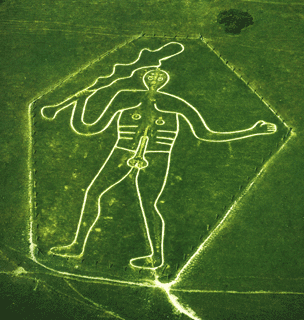
Because we don't have enough religious groups complaining about things being 'disrespectful', a bunch of pagans have decided to get in on the act, complaining about Trinny and Susannah giving the Long Man of Wilmington "temporary pigtails, breasts and hips". Look, you imbeciles, he is the Long Man of Wilmington. He may not be the Cerne Abbas giant, but he is close enough to the male principle to be entirely secure in his sexuality. Think of all the mythic heroes who do their time in drag! He will get over it, and I suggest you follow suit. And if we're talking "disrespectful", then you so-called 'druids' and the impostor who dares to take the name 'Arthur Pendragon' ought really to start looking a little closer to home, don't you think? Oh, I hate special interest groups. A twin pressure group complaining that Big Brother is being twinnist, apparently failing to spot that the twins were not made this way by Endemol. That retarded screed doing the LJ rounds about supposed racism in Doctor Who. The world is drowning in a swarm of tiny minds who can only process any stimulus through whether it fits their own cast-iron agenda as it affects their own tunnel-vision area of interest.

Rome's second series was losing me for a little while, but has regained my attention by the simple expedient of going totally bugfvck insane. Gratuitous lesbian org1es! Octavian suddenly replaced with another actor who looks not the slightest bit like the last one! Torture scenes all over the place! A sustained challenge to what had always been assumed to be Oz's lifetime hold on HBO's bumrape crown! And above all - Mark Anthony's spectacularly unflattering beard! I can increasingly see why they had to stop after this series - there would simply not have been anywhere loopier to go short of recasting Britney Spears as Cicero.
alexsarll: (bernard)
Some further thoughts on Doctor Who:
On Sunday, the top of the up escalator at Bermondsey station was doing the Sound of Drums...diggerdydum, diggerdydum, diggerdydum...
Never mind getting Widdecombe to endorse Saxon - they should do a whole episode with Lembit Opik as himself, teaming up with the Doctor to avert some asteroid-related threat. I'm sure he'd be up for it.
The design of the Citadel confirmed me in my suspicion that Arthur C. Clarke's The City and the Stars was a significant influence on the portrayal of Gallifrey.
I really hope they at least leave enough unsaid about the Paradox machine that unreconstructed geeks such as myself can tie it in to the marvellous Faction Paradox lunacy of the books.

It was bad enough having Johnson from Peep Show in Hyde, but now Super Hans is working for him! It's a grand week for TV, though, isn't it? This and Who, two episodes of Rome, and on Friday, the return of The Shield, the one other cop show which, if not The Wire's equal (what is?), can at least look it in the eye. Oh, and last night BBC4 decided, for some opaque and unguessable reason, to show the delightful Yes, Minister special in which Jim Hacker ascends, unopposed, to Prime Ministership, following it with a documentary about ex-PMs. The most remarkable detail of this was how much enhanced John Major looks nowadays; he's more charismatic, happier, the voice less nasal, even the upper lip less offputting. The voiceover concluded that every PM, secretly, would love to return to running the show, but in everything Major said, every twinkle in his eye, you could tell that he really wouldn't. He's been there, done that, and concluded that he really does much prefer the cricket.

I am otherwise musing on the peculiar obscurity of Weird Al Yankovic's UHF (which really should be considered in the mainstream of eighties American teen comedies, rather than as a cult oddity), the sheer manliness of Glengarry Glen Ross (arguably even more male than Conan the Barbarian, the otherwise unchallenged champion), and the utter Englishness of W.Somerset Maugham selling his soul to Aleister Crowley for worldly success, and then grudging him £50 once Crowley was on his uppers.
alexsarll: (magnus)
I never took to Gaslight on screen (I may have attempted the wrong version), but the Old Vic's stage version was another matter. It's much stronger for observing the unities...well, most of them; for a psychological thriller, once or twice it does come a little close to French farce, at least once accidentally. The Bond girl and Pompey both give excellent performances, but the surprise for me was Andrew Woodall; where Anton Walbrook was far too obviously sinister as the husband, he makes a believable Victorian paterfamilias, much more ambiguous as he infantilises his wife, much more plausible. And the real surprise for me was how much that theme's played up, how strong a feminist statement the play makes - because from the four novels I've read, most of Patrick Hamilton's women are absolute bitches.

After a whole season of Russell T Davies smugly grinning and SFX techs geeking, I abandoned Doctor Who Confidential, but I made an exception for the Stephen Moffat episode because Moffat always gives good interview. I had no idea, though, that we'd get him and Tennant interviewing each other around Television Centre and a generall great documentary out of it. But the most moving bit came, surprisingly, from RTD, when he talked about how, as a kid, he always thought that at any moment you could turn the corner and see the TARDIS there, door half-open.
Which reminded me of the TARDIS-a-like 'phone box in Derby Children's Hospital, and rushing towards that half-open door, and finding only a payphone inside. I wonder if that's where it all began to go wrong?

Didn't make it to Stokefest in the end - my sources informed me of crowding, and summer crowds are not my idea of fun. But the local history...that I liked. Rampaging elephants! Bob Hoskins! Mutant milkmaids! Finsbury Park has had it all. Maybe even Ho Chi Minh, though the evidence there was hazier. Plus, the definitive sources on all this include the work of Ken Gay. Now, you'd think a name like that was hard to beat, right? But you'd be reckoning without his collaborator, Dick Whetstone.

Never mind the stripper vicars - what about a flasher judge?

December 2017

S M T W T F S
     12
3456789
10111213141516
1718192021 2223
24252627282930
31      

Syndicate

RSS Atom

Most Popular Tags

Style Credit

Expand Cut Tags

No cut tags
Page generated Mar. 13th, 2026 09:36 pm
Powered by Dreamwidth Studios